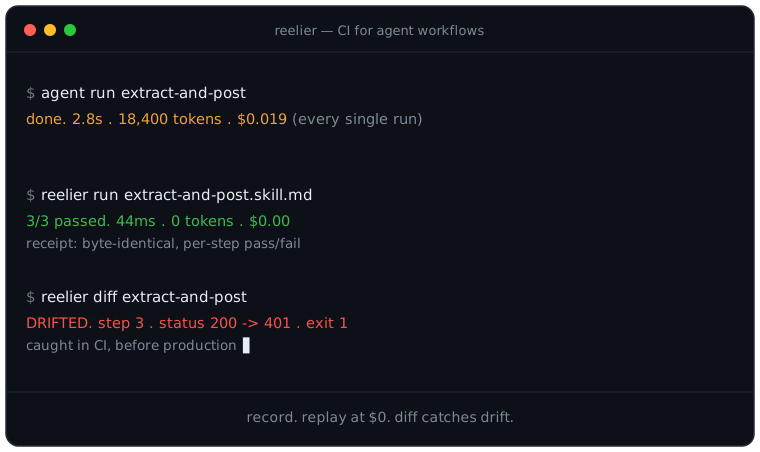
Record the run that worked. Replay it deterministically. Every write comes back as a signed receipt.
$npm i -g reelier && reelier initWorks inside your agent. Records from your sessions. Replays with any model.
None of these threw. All of them were found by users.
openai 1.99.1 → 1.99.2A patch. Tool type mappings changed, so replaying a conversation that contains tool calls throws. The first request in a session still passes, which is why it clears CI and fails in production. the issue →
langchain 0.4 → 1.xTool arguments started arriving as stringified JSON, so calls were quietly re-bucketed as malformed. No exception. From the outside the agent simply stopped using its tools. the issue →
crewai 0.165.1 → 0.177.0Every tool began firing twice, milliseconds apart, with no error and duplicated side effects. Closed as not reproducible, because by the time it was reported the evidence was gone. the issue →
A type-check and a unit test both pass in all three cases. What changed was the sequence of tool calls, and nothing was watching that.
mainIllustrative — a product rendering of a real GitHub PR, not a captured screenshot.
A receipt proves scope and change — never that the change was correct or safe. Nothing certifies that.
See a live one on a real PR → github.com/seldonframe/reelier/pull/27
A ladder of graded claims, never a blanket ✓.
None of this proves a run wasn’t fabricated before it was recorded — signing proves unaltered-since-push, timestamps prove existed-by-T, attestation proves which CI pushed it. It makes faking expensive, never impossible.
Don’t trust — verify. Paste any Reelier receipt and check it yourself.
- Determinism. Does this still do what it did?
reelier run <name>.skill.md— same steps, 0 tokens. - Drift. Are the tools still the tools?
--wrap "<your mcp server>"checks the manifest before step 1, so schema drift fails closed. - Recovery. If step 3 broke, would it heal?
--fail 3runs the real escalation ladder against a synthetic failure, with no side effects.
Taxonomy due to Mads Hansen’s review.
replays byte-identical (N=1000 tail-variance test). MEASURED
per replay, verified from the run record rather than assumed.
than the agent re-running the same task. Full method in examples/benchmark.
Bounded before.
Per-step approval hashes and a declared scope, checked before a write goes out — a fail-closed gate built with design partners today. STRUCTURAL
Attested after.
Every run comes back as a signed receipt, graded on the trust ladder — not a blanket “it worked”, a record of what state it left behind. STRUCTURAL
Answerable forever.
Every receipt gets a permalink in a hash-chained audit log, and a badge you can embed — so “what did it do” has an answer months later, not just at merge time. STRUCTURAL
Local Reelier is complete and free forever. Sign in with GitHub to push receipts to a hosted ledger, run skills on a schedule while your laptop’s closed, and share any receipt as a public permalink with a verified-replay badge — a deterministic, assertion-checked replay, not a cryptographic signature.
Sign in with GitHub →Gate your next dependency bump.
Let the diff convince you.
$npm i -g reelier && reelier init
— the 2.4.0 release changed the response shape · 0 tokens · CI-attested · signed · timestamped